
How to Search Criminal Dockets
Start at the Fannin County Public Court Records Search, which opens Odyssey Public Access. The menu splits Criminal Case Records from civil records and the court calendar. Pick the right court before you pick criminal. Felony cases run through the 336th Judicial District Court and the District Clerk. County Court at Law misdemeanors sit with the County Clerk instead. City and justice-court files may never show up here at all.
A cause number is your safest search term when you have one. The live form's labels are the authority. No fixed Fannin County number format is published. Trust what the screen shows rather than guessing. Once results appear, check the details. Match the court, the filing date, the charge, and the status against what you already know.
- Open the county records page and Odyssey.
- Select Criminal Case Records.
- Use the narrowest verified identifier.
- Read each charge, setting, order, plea, and disposition separately.
- Request the named document from the correct clerk when needed.
Fannin Criminal Docket Routes
Fannin County splits its criminal records across two offices. The District Clerk holds the felony dockets. The County Clerk keeps County Court at Law misdemeanors, with published examples covering DWI, theft by check, marijuana possession, criminal trespass, and tampering with government records. Searching the wrong office, even with the right name, can return nothing at all.
| Matter | Keeper | Fallback |
|---|---|---|
| Felony | District Clerk | 903-583-7459; dcrecords@fanninco.net |
| County misdemeanor | County Clerk | 903-583-7486 |
| Class C or local | Issuing city or JP | Contact the court on the citation |
An older criminal block lists 903-583-8502 at a different location. Confirm before dialing; the current general County Clerk contact is the one that controls.
What a Criminal Docket Shows
A Fannin County criminal docket is a timeline, not a single verdict. Entries can cover charging, arraignment, pretrial settings, motions, orders, plea or trial, judgment, sentencing, and appeal. Local event codes have no published list, so read each live label in full.
| Cause number | The court identifier used for search and copy requests. |
|---|---|
| Charge | The alleged offense, not proof of conviction. |
| Setting | A scheduled arraignment, hearing, pretrial event, or trial. |
| Plea or order | A response or judge's direction recorded as its own event. |
| Disposition | The recorded outcome, checked against the signed judgment. |
Event lines can appear without any document images attached. A browser printout is not a certified judgment. Find the event first, then ask the clerk for the filed order or judgment behind it.
Read Fannin Criminal Case Events
Each term on a Fannin County docket marks a distinct point in the case. Keeping them apart stops a mere charge, a moved date, or a reporting status from being read as a result.
- Arraignment
- An appearance where charge, rights, and plea issues may be addressed.
- Reset
- A setting moved to a new date; it does not end the case.
- Disposition
- The recorded outcome or status.
- Judgment
- The signed court decision, distinct from the event line.
- Inactive
- An OCA reporting category, not automatic dismissal.
Indictment, plea, order, and judgment sit on separate lines. When wording is unclear, give the clerk the exact event date and cause number.
Stages on a Criminal Docket
Most felony files follow a familiar shape. Filing puts the charge into the court record. Arraignment handles charge and plea questions. Pretrial settings cover motions, readiness, and scheduling. A plea or trial can then bring disposition, judgment, and sentencing. Later motions or an appeal stretch the docket further, and no Fannin County case is required to hit every stage.
Docket flow: Filing › Arraignment › Pretrial › Plea or Trial › Disposition › Sentencing
A reset moves the calendar only; it decides nothing on the merits. Nor does an inactive statistical entry prove a case is over. Look to the disposition and the signed judgment.
Fannin Criminal Clerk Channels
The District Clerk handles criminal files, indictments, jury work, appeals, post-conviction filings, and archives. A good request names the court, cause number, event or document, date, and copy type. Email dcrecords@fanninco.net or call 903-583-7459. Current notices say in-person service runs by appointment. Written requests can also be mailed to 200 E. 1st Street, Bonham. No fixed response time is published, and older files may sit off-site. The schedule lists a $5 search, $1 per paper or conversion copy, electronic pages at $0.10 with a $1 minimum, and a $5 certification line. Confirm the total before paying. Certification authenticates a copy without changing the docket event itself.
For a setting in the 336th District Court, the coordinator is Brandi Todd. She is listed at 903-583-2863 and btodd@fanninco.net. The coordinator confirms dates. The District Clerk owns the records. County Clerk misdemeanor requests go through its general line. Municipal or JP matters stay with the court that issued them.
Which Court Holds Criminal Dockets
Criminal dockets in Fannin County split across several courts. Felonies belong to the 336th Judicial District Court, while the County Court at Law handles misdemeanors through the County Clerk. Justice and municipal courts run their own fine-only and local dockets. If you are unsure where a case sits, check the charging document first, since it usually points to the right court.
Appeals from these courts go to the Sixth Court of Appeals. Federal matters run through Eastern District of Texas systems instead of Odyssey. Each layer keeps its own records and its own clerk.
The official 336th District Court page lists the court staff and coordinator details you may need before a hearing.
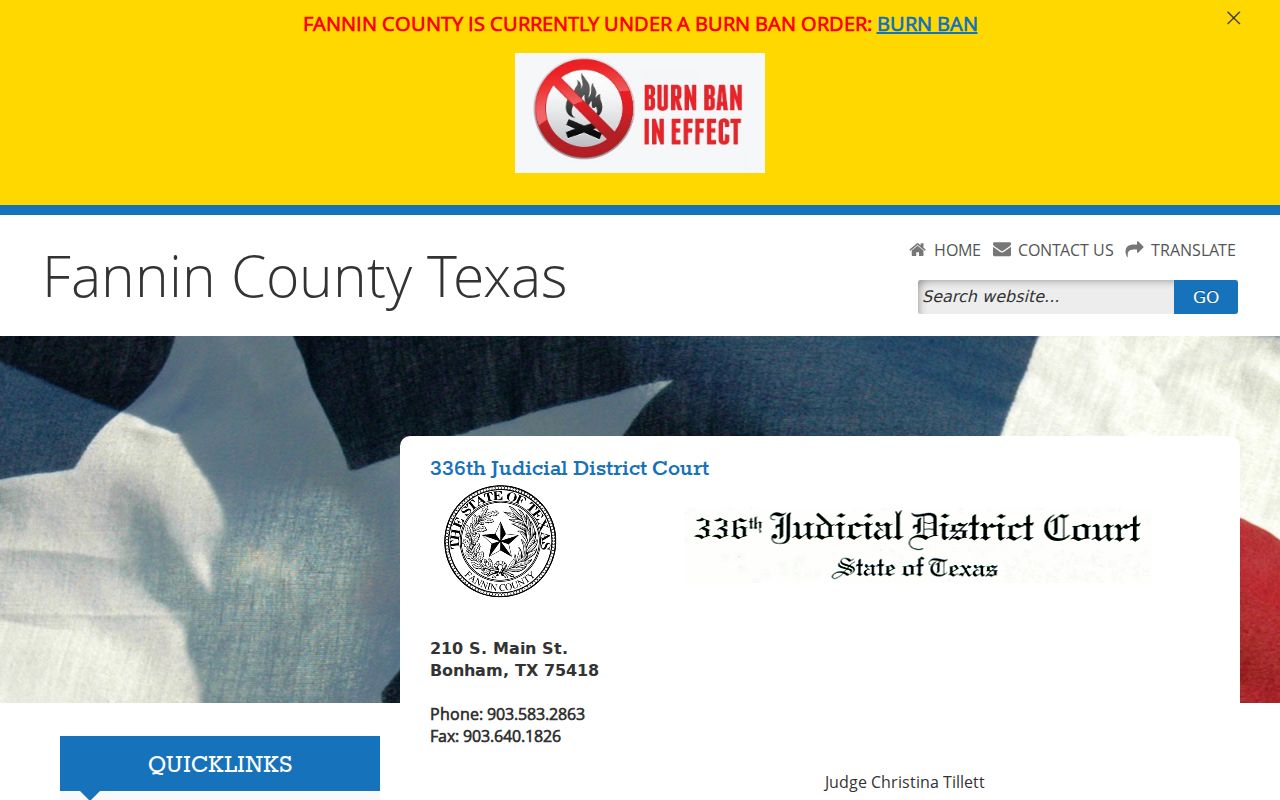
The court profile confirms that felony settings belong there, while copies stay a District Clerk function.
Fannin Criminal Docket Activity
The FY2024 OCA summary covers September through August. It reported 216 criminal matters pending at the start, 146 reactivated, 342 added, 358 disposed, 146 inactive, and 182 pending at the end.
These activity columns describe docket events, not people or verdicts. Read the full Fannin County criminal docket entry for a case before you draw any conclusion about what happened in it.
Missing Fannin Criminal Records
A blank search result is not the end of the road. A Fannin County criminal docket can still exist even when nothing appears online. The case may sit in another court. Older files, off-site storage, pending indexing, and restricted records all hide cases from the web view. Odyssey only shows what has been approved for online release. Plenty of older Fannin County court records must be pulled by hand, so treat "not found" as a lead rather than a conclusion.
Know which clerk to call. Felony cases live with the District Clerk, and County Court at Law misdemeanors live with the County Clerk. For lower-level cases, go to the issuing city or precinct. The statewide option is re:SearchTX, an account-based case and document search that offers alerts where available. Do not confuse it with eFileTexas, which handles filings. When an event has no image, request the document rather than assuming it was never filed.
A good request speeds retrieval. Give the name as recorded, the cause number if known, the court, a date range, and the exact item you want, and say whether you need plain, electronic, or certified form. Ask about redaction, restriction, or off-site storage too. The clerk publishes no official response time, so build in room for retrieval and confirm how the result will be sent.
Public Access and Sealed Criminal Dockets
Not every Fannin County criminal docket is open online. Expunction and nondisclosure are two different things. Juvenile or protected matters can be restricted as well. Missing data says nothing about the merits or the outcome. What appears on the internet is narrower than the clerk's internal case file, and a public event line does not guarantee that the linked filing image is public too.
Key rules:
Code of Criminal Procedure Chapter 55A governs expunction effects.
Government Code Chapter 411 contains nondisclosure rules.
Texas court records policy directs ordinary case requests to the clerk.
Rule 12 covers judicial records outside the case file. For a docket or a filed document, ask its clerk. Request a public redacted copy if one exists. If access is denied, ask which rule or statute controls. Ask whether a redacted version can come out. Also ask whether the decision concerns an ordinary case record or a separate Rule 12 judicial record. The two follow different paths. A Rule 12 denial has its own review process. An ordinary criminal case file stays a clerk matter.
The Texas Public Information Act does not convert the court's case file into a routine executive-agency request. Start with the court that created the record. That keeps the docket search aimed at the right office. It also avoids confusing a public docket, a criminal-history product, and a certified court document, since each serves a different purpose and can hold different information.